
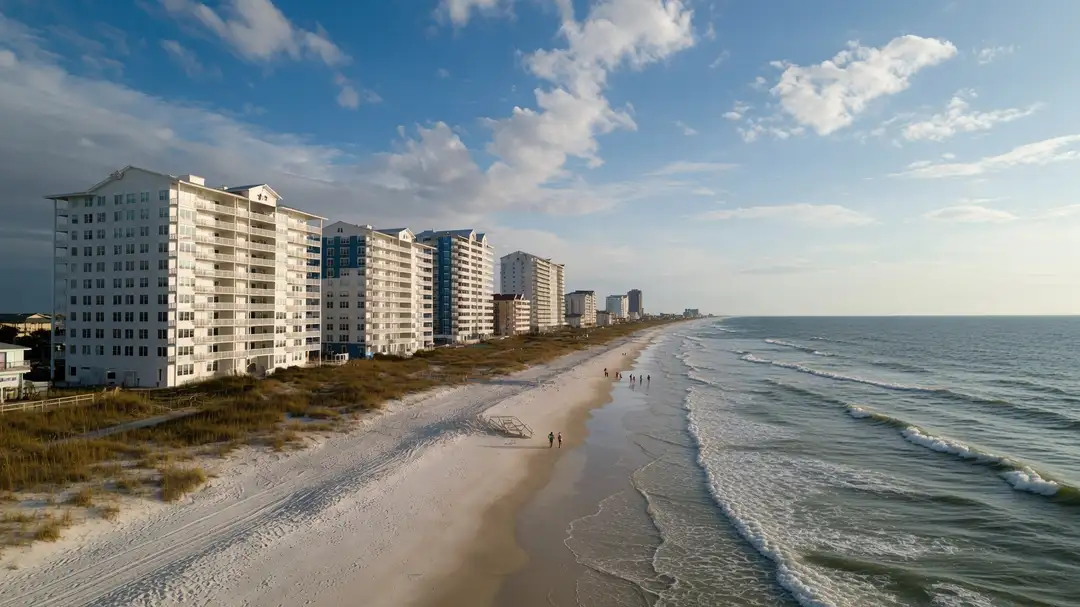
Apartment complex insurance for Destin, Fort Walton Beach, and Okaloosa and Walton counties
Coastal habitational property, wind, flood, and liability for owners of whole apartment communities, from a broker based in Birmingham and placing nationwide.
The short answer
Apartment complex insurance in Destin and Fort Walton Beach comes down to five checks: your hurricane deductible as a percentage of insured value, whether your wind sits with an admitted carrier, Citizens, or surplus lines and what that costs all in, how far flood coverage reaches past the NFIP limit, your roof history, and how Florida’s security liability rules fit your policy. We place accounts with $50,000 or more in annual premium.
General information, not legal, tax, or coverage advice. What's covered depends on your specific policy wording, and the policy controls. Current as of November 2026.
What drives apartment complex insurance cost in Destin and Fort Walton Beach?
Wind, and who is willing to write it. For an owner of a whole complex in Okaloosa or Walton County, the terms turn on the hurricane deductible, whether the program sits with an admitted carrier, Citizens, or the surplus lines market, and how far flood coverage reaches. Roof condition and Florida’s security liability rules come next. This page is for owners, developers, and CFOs insuring entire communities, not renters or condo associations.
We are based in Birmingham and place habitational accounts nationwide. Where Dan isn’t licensed, placement goes through a producer licensed in that state.
What storm history do underwriters price into a Destin or Fort Walton Beach complex?
Hurricane Opal came ashore at Pensacola Beach on October 4, 1995 as a marginal Category 3. The National Hurricane Center estimates winds of 100 knots in a narrow swath at the coast near the eastern tip of Choctawhatchee Bay, about midway between Destin and Panama City, and describes extensive surge and wave damage over most of the Panhandle coast (NHC report on Opal). In 2004, Hurricane Ivan pushed 10 to 15 feet of surge along the coast from Destin westward to Mobile Bay and 6 to 9 feet from Destin eastward (NHC report on Ivan). Destin sits on the line between those two zones.
Opal’s strongest estimated winds were near Choctawhatchee Bay. Ivan made landfall near Gulf Shores, Alabama, and still put surge on the Okaloosa coast. Wind and surge are separate losses on separate policies. Wind sits on the property policy under its own deductible. Surge and rising water need a flood policy with its own limit and deductible. An underwriter reads each building’s address, elevation, distance to the Gulf or a bay, and construction, not the city name.
How do hurricane deductibles work on a Florida apartment complex?
Florida regulates how commercial residential hurricane deductibles are offered. Under Fla. Stat. § 627.701, an insurer on a commercial residential policy must offer both an annual aggregate and a per-hurricane deductible, and may offer a deductible of up to 10% of insured value if it also offers a 3% option at the offer and at each renewal. On a $10 million building, 3% is $300,000 retained and 10% is $1 million. Which of your policies the statute reaches is a question for whoever places the program.
Run your schedule in the wind deductible calculator and see what a buy-down costs per dollar of retention removed. If the loan is Fannie Mae or Freddie Mac, the named storm terms also have to pass agency review. Our Fannie Mae and Freddie Mac named storm guide covers where coastal programs fail it.
Where does Citizens fit for a Destin or Fort Walton Beach apartment complex?
By statute, Citizens Property Insurance “may not offer new commercial residential policies providing multiperil coverage” but continues to offer commercial residential wind-only policies (Fla. Stat. § 627.351(6)). Citizens’ own commercial submission guide says that to establish eligibility you must first shop the risk with private-market carriers (Citizens guide). Whether a given address qualifies for wind-only is a lookup on Citizens’ site, so check the address rather than the county.
A 2026 law narrows the door further. CS/CS/SB 1028 (chapter 2026-150), approved on June 16, 2026, makes a commercial residential risk ineligible for Citizens when it receives a comparable surplus lines offer costing no more than 15% above Citizens’ total cost, counting premium, fees, taxes, and assessments. It also requires Citizens to implement a separate commercial lines clearinghouse for surplus lines offers on or before January 1, 2027 (Florida Senate). Read the bill text for how “comparable” is measured. A surplus lines offer can now decide whether a risk stays eligible for Citizens.
On the Gulf Coast, wind for larger apartment complexes is often placed in the surplus lines market, with primary and excess layers from more than one carrier. Our catastrophe and coastal property program explains how the layers are built.
What does surplus lines wind add to the cost in Florida?
Florida charges a premium tax of 4.94% of gross premium on surplus lines policies, collected by the surplus lines agent (Fla. Stat. § 626.932), plus a Florida Surplus Lines Service Office fee of up to 0.3% paid by the insured (Fla. Stat. § 626.9325). On $200,000 of premium, the tax alone is $9,880. Compare programs on the all-in cost, which is also how the Citizens comparison above is measured.
Two protections differ. The disclosure a surplus lines insured must acknowledge says that insureds are “not protected under the Florida Insurance Guaranty Act” for an insolvent unlicensed insurer, and that surplus lines rates and forms are not approved by any Florida regulatory agency (Fla. Stat. § 626.916). And the Florida Hurricane Catastrophe Fund’s definition of a covered policy excludes policies issued by a surplus lines insurer (Fla. Stat. § 215.555). Review the carrier’s financial strength before you accept a quote.
How does Florida's 25% roof rule affect an apartment roof?
Under Fla. Stat. § 553.844(5), if a roof was built, repaired, or replaced to the 2007 Florida Building Code or a later edition, and 25 percent or more of it is being repaired, replaced, or recovered, only the repaired portion has to meet the code in effect. Local governments cannot amend that exception. The text is conditioned on a 2007-or-later roof, so the building’s roof history decides which rule your contractor is working under.
Underwriters ask for roof age, covering, and replacement date, and some programs settle roof losses at actual cash value. Put roof records in the submission before the underwriter has to ask, and read the roof settlement terms and any ordinance or law wording on the quote.
Is flood covered, and is the NFIP limit enough for a complex?
Standard commercial property forms exclude flood. The National Flood Insurance Program caps building coverage for an “other residential building (including multifamily building)” at $500,000, and residential contents at $100,000 (44 CFR 61.6). Residential condominium buildings are rated differently, so the figure matters for a garden or mid-rise apartment community. Against a $10 million building, $500,000 is 5% of value. Excess flood from private markets is how owners cover the rest.
Flood here also comes from creeks and rain. In Hurricane Sally in 2020, Alaqua Creek in Walton County rose above its record flood stage and flooded homes along State Road 20 west of Freeport with up to 4 feet of water, and the I-10 bridge over the Shoal River in Okaloosa County was closed (NHC report on Sally). A flood map shows where a lender requires coverage. Confirm each building’s zone and your lender’s requirement.
How do Eglin and Hurlburt leases affect an Okaloosa apartment community?
Eglin Air Force Base and Hurlburt Field are in Okaloosa County, so owners here should expect some service members on the rent roll. We have no reliable figure for the share, so check your own. Two rules let a servicemember with qualifying orders end a lease early. Federal law lets a monthly lessee terminate effective 30 days after the next rent payment is due following notice, with no early termination charge (50 U.S.C. 3955). Florida allows termination on at least 30 days’ written notice for reasons that include a permanent change of station of 35 or more miles, and the right cannot be waived (Fla. Stat. § 83.682).
Those rules can raise turnover and vacancy at a community. Rental income coverage generally responds to a covered physical loss, not to tenants ending leases, so ask your carrier how yours is worded. Underwriters may also ask about lease terms and concentration in the rent roll.
What does Florida law say about crime at an apartment complex?
Since 2023, Fla. Stat. § 768.0706 gives owners of multifamily property, meaning five or more units on a parcel, a presumption against liability for third-party crime if they substantially implement a statutory checklist: cameras, lighting, locks, a recent CPTED assessment, and employee training. The owner carries the burden of proving it did (statute). Under § 768.81(6), a party found more than 50 percent at fault for his or her own harm may not recover damages (statute).
The presumption is a liability defense, not a coverage term. Check the assault and battery sublimit, whether defense costs erode it, and whether your umbrella follows form. Our Florida negligent security guide has the full checklist and the records to keep. It is general information, not legal advice, and a lawyer licensed in Florida can say how the rules apply to a specific claim.
Case study
A 1940s apartment community
~$50M
insured value, two catastrophe carriers competing
The owner had renewed with the same agent for years, and the results never changed, no matter what the market was doing. The premium had climbed to the point that the property was losing money, and he didn't believe his agent was doing the work the account needed. With close to $50 million in total insured value, a property built in the 1940s gets priced on its age unless someone shows the underwriter what's actually there.
So we did. Our team documented the risk controls and the full COPE picture (construction, occupancy, protection, and exposure), then brought in a risk modeling team to put numbers behind it. Underwriters price what they can see. We made sure they could see everything.
With that data in hand, we took the account to market and got two major catastrophe carriers bidding against each other. On that account, the renewal closed $130,000 lower than the year before. One client's result; yours will depend on your properties, loss history and the market.
He was also up against a financing deadline. We kept the lender, the owner, and the carriers aligned, and the program was bound in time.
Results depend on each account’s exposures, loss history, and market conditions at renewal. Past results don’t guarantee future savings.
How do we price your Destin or Fort Walton Beach apartment account?
We start with your schedule of values, loss runs, and expiring policy, then model the premium against NOI, value at your cap rate, and cost per unit in the multifamily insurance calculator. We size the wind and flood retention together and compare the options on an all-in basis, including taxes and fees. We don’t quote or bind anything until you have reviewed it, and results depend on your exposures and the market at renewal.
Common questions
Do you insure apartment complexes in Destin and Fort Walton Beach?
We are based in Birmingham and place habitational accounts nationwide. Where Dan isn't licensed, placement goes through a producer licensed in that state.
Does this apply to renters insurance or condo associations?
No. This page is for owners, developers, and CFOs insuring whole apartment communities. Renters insurance is bought by the tenant, and condo associations have their own page.
Do surplus lines policies have Florida guaranty fund protection?
Florida's required surplus lines disclosure says insureds are not protected under the Florida Insurance Guaranty Act for the obligations of an insolvent unlicensed insurer. Review the carrier's financial strength before you accept a quote.
What size apartment account do you handle?
Accounts with roughly $50,000 and up in annual premium, from a single large community to multi-state portfolios.
This article is for general educational purposes only. It isn't legal, tax, accounting, or lending advice and doesn't create a producer-client relationship. Policy terms, exclusions, and availability vary by carrier, state, and property. Only the policy actually issued determines coverage. Regulatory and lender requirements change; confirm current rules with your attorney, lender, or servicer before relying on anything here.
Free renewal review
Send your Destin or Fort Walton Beach apartment renewal date
We'll reply within one business day with when to start marketing it and what to have ready. Built for accounts with $50,000+ in annual premium.
- A second set of expert eyes on your program, free.
- Marketed to the carriers that actually want your risk.
- No obligation, fully confidential.
Book 20 minutes or call (205) 999-4884